
High-temperature CO2 electrolysis
Solid oxide electrolysis cells convert CO2 (and steam) into CO and syngas at 700–850 °C, a route to synthetic fuels.
Read more →Department of Inorganic and Physical Chemistry · Indian Institute of Science
LEIS
We develop multimodal operando diagnostics that combine electrochemistry, spectroscopy, impedance and live imaging to understand and develop solutions to bottlenecking challenges in electrocatalysis. We carry out deep diagnostic study of materials and processes under a wide range of conditions and uncover key performance indicators/descriptors.
Led by Chinmoy Ranjan, Indian Institute of Science, Bengaluru




8 researchers in the lab, our PI and 9 alumni.
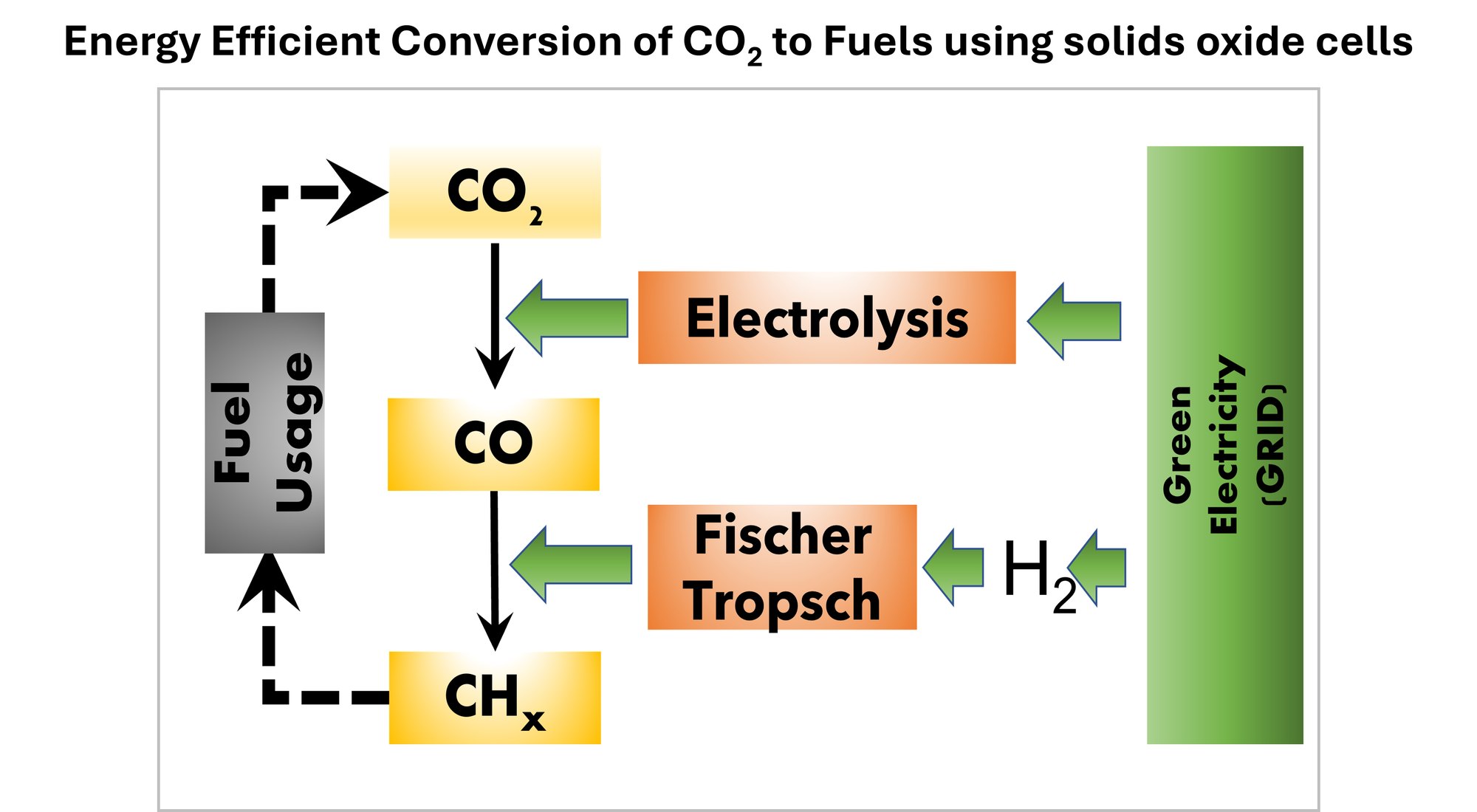
High-temperature CO₂ electrolysis, oxygen reduction and evolution, hydrogen at platinum and ion transport.
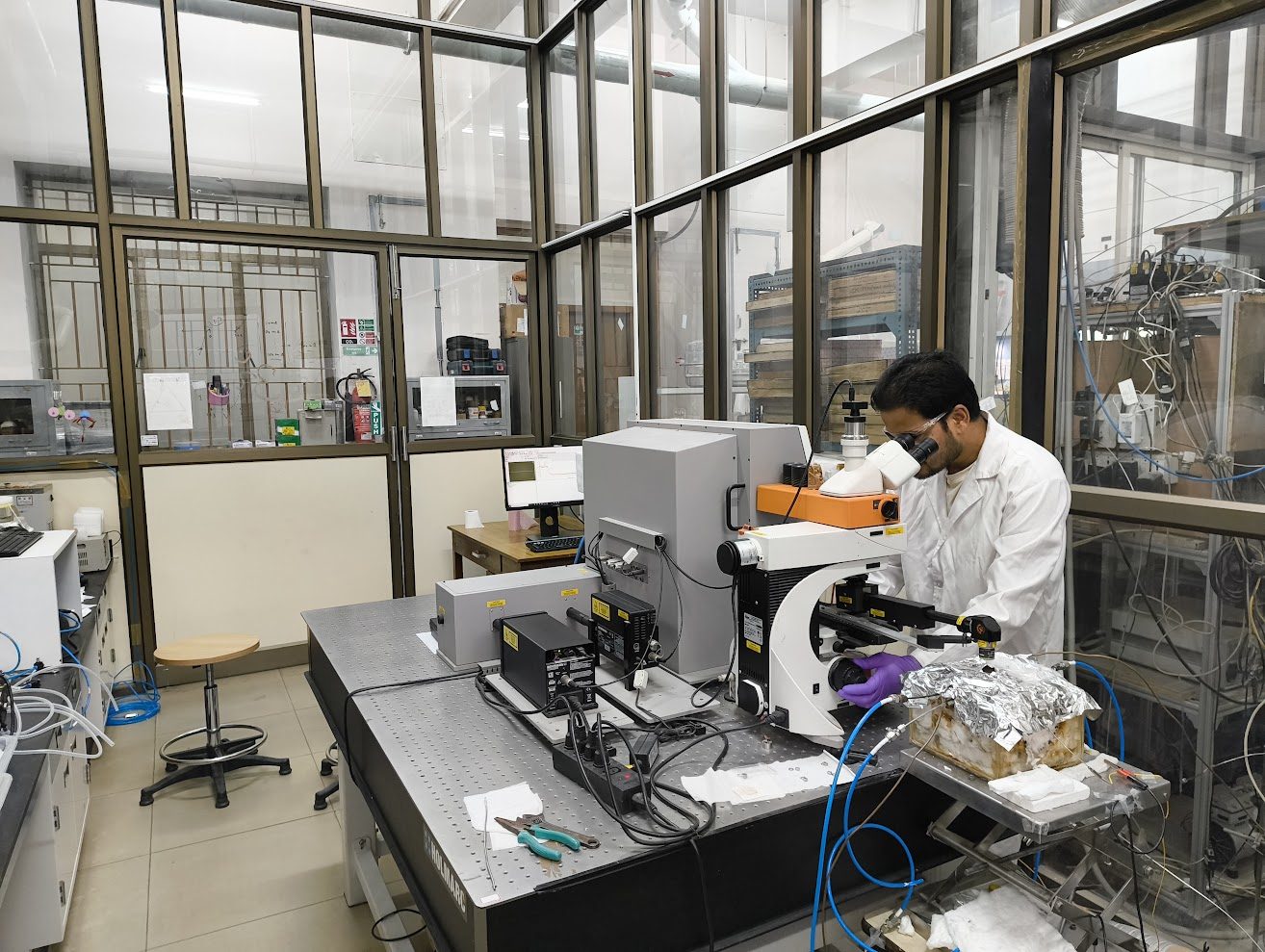
Operando Raman, mass spectrometry and test stations at up to 800 °C.
News, prizes and milestones: best-thesis and best-paper awards, talks and defences.
Peer-reviewed papers, reviews and book chapters.
PhD, postdoctoral and project openings, and how to apply.
Chinmoy gave an invited talk at the 19th Asian Conference on Solid State Ionics (ACSSI-2026), Bangkok.
Shivam: ACS Omega Best Poster Award, 13th Asian Conference on Electrochemical Power Sources (ACEPS-13), Bengaluru. Poster: CO2 reduction in SOEC for flue gas compositions
Soham Raychowdhury: ACS Best Poster Award, 13th Asian Conference on Electrochemical Power Sources (ACEPS-13), Bengaluru. Poster: Theoretical studies of CO2 reduction on doped ceria electrodes
Congratulations to Dr. Veenu on completing her PhD on adsorbed hydrogen in Pt-based electrocatalysis.
New ANRF core research grant (co-PI) on first-principles and data-driven multiscale modelling of CO2 electroreduction catalysts, 2026–2029.
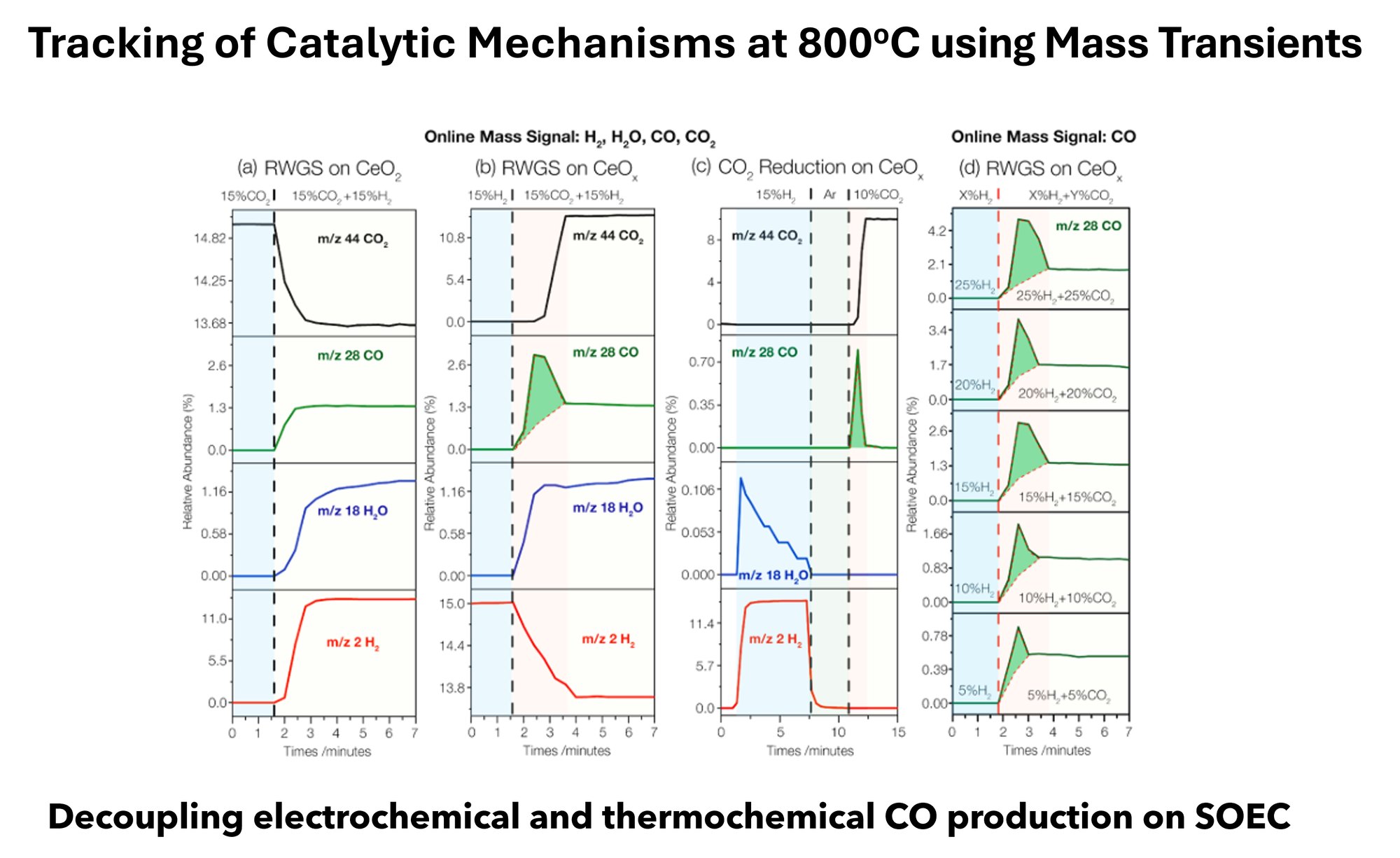
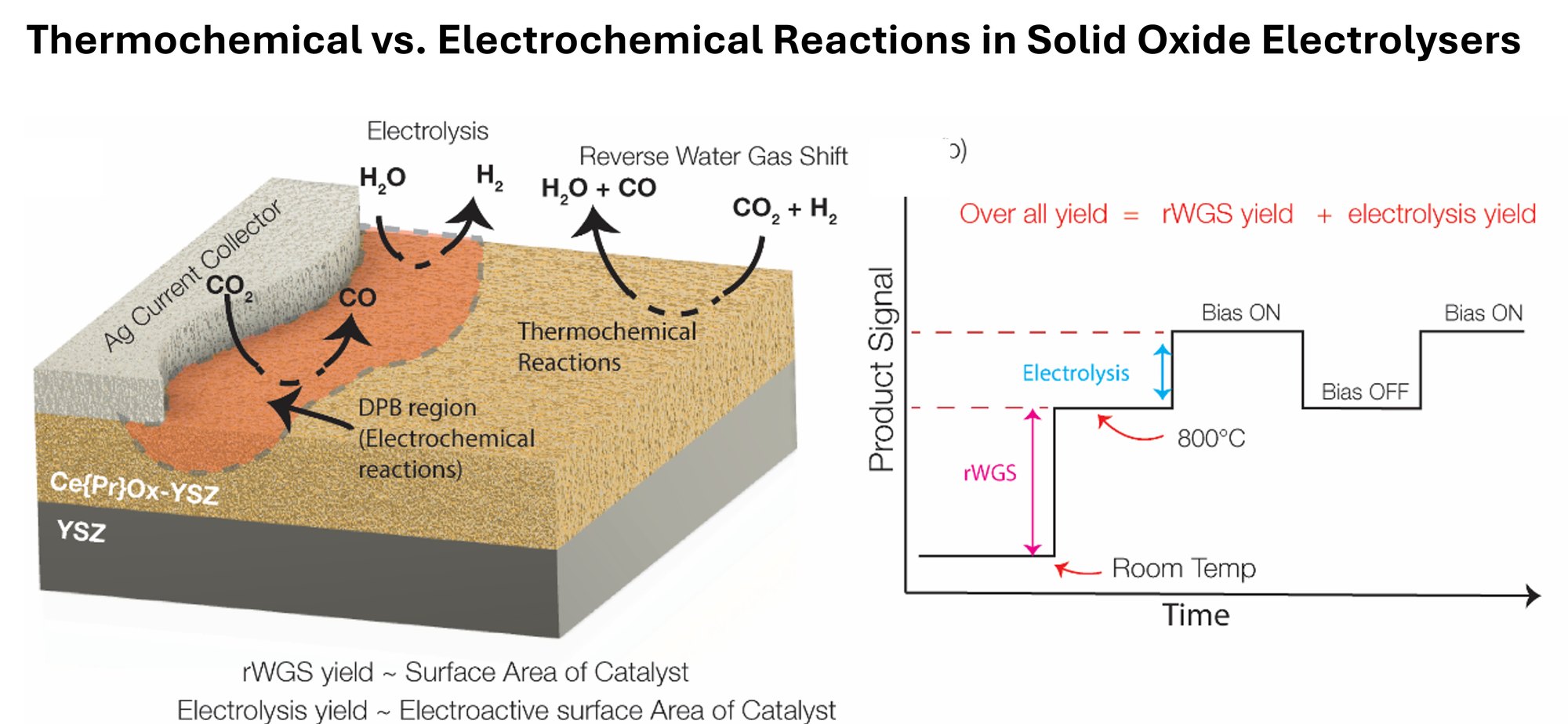
Paper on controlling CO selectivity and coking on doped-ceria electrodes with applied bias published in J. Mater. Chem. A.
Paper on the unusual redox behaviour of doped ceria in H2 published in ACS Applied Materials & Interfaces.
Congratulations to Dr. Bapuji Mohapatra on completing his PhD on mixed metal oxide electrodes for oxygen evolution. He has joined Thermax, Pune.
Solid oxide electrolysis cells convert CO2 (and steam) into CO and syngas at 700–850 °C, a route to synthetic fuels.
Read more →Fuel cells need cathodes that reduce oxygen completely to water without precious metals.
Read more →The oxygen evolution reaction limits the efficiency of water electrolysis.
Read more →Adsorbed hydrogen controls reactivity on platinum in hydrogen evolution and in the oxidation of small molecules such as formic acid.
Read more →We measure oxide-ion and proton conduction in solid electrolytes and ion transport in polymer membranes such as Nafion, using impedance, multi- electrode methods, Raman spectroscopy and DFT.
Read more →
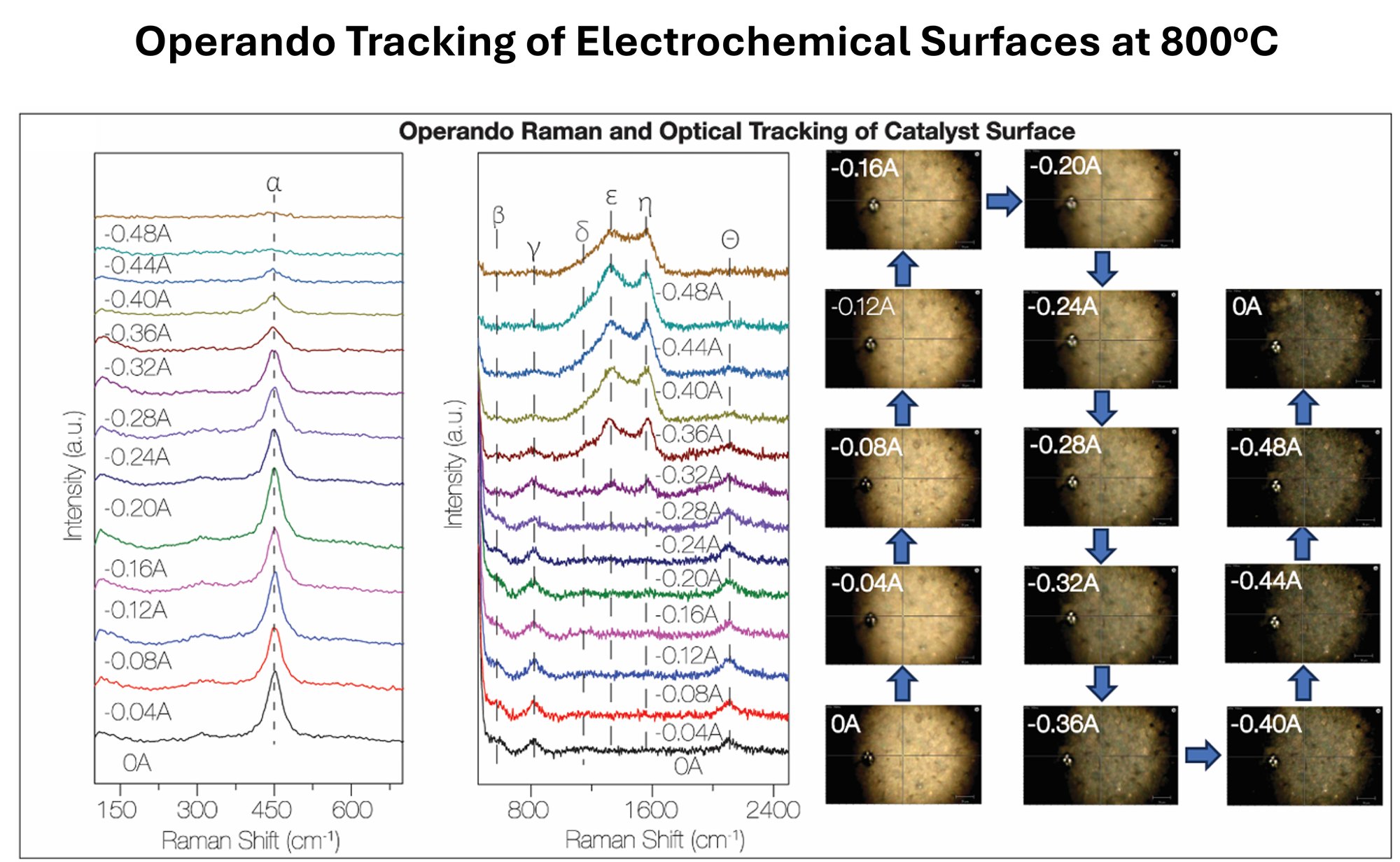
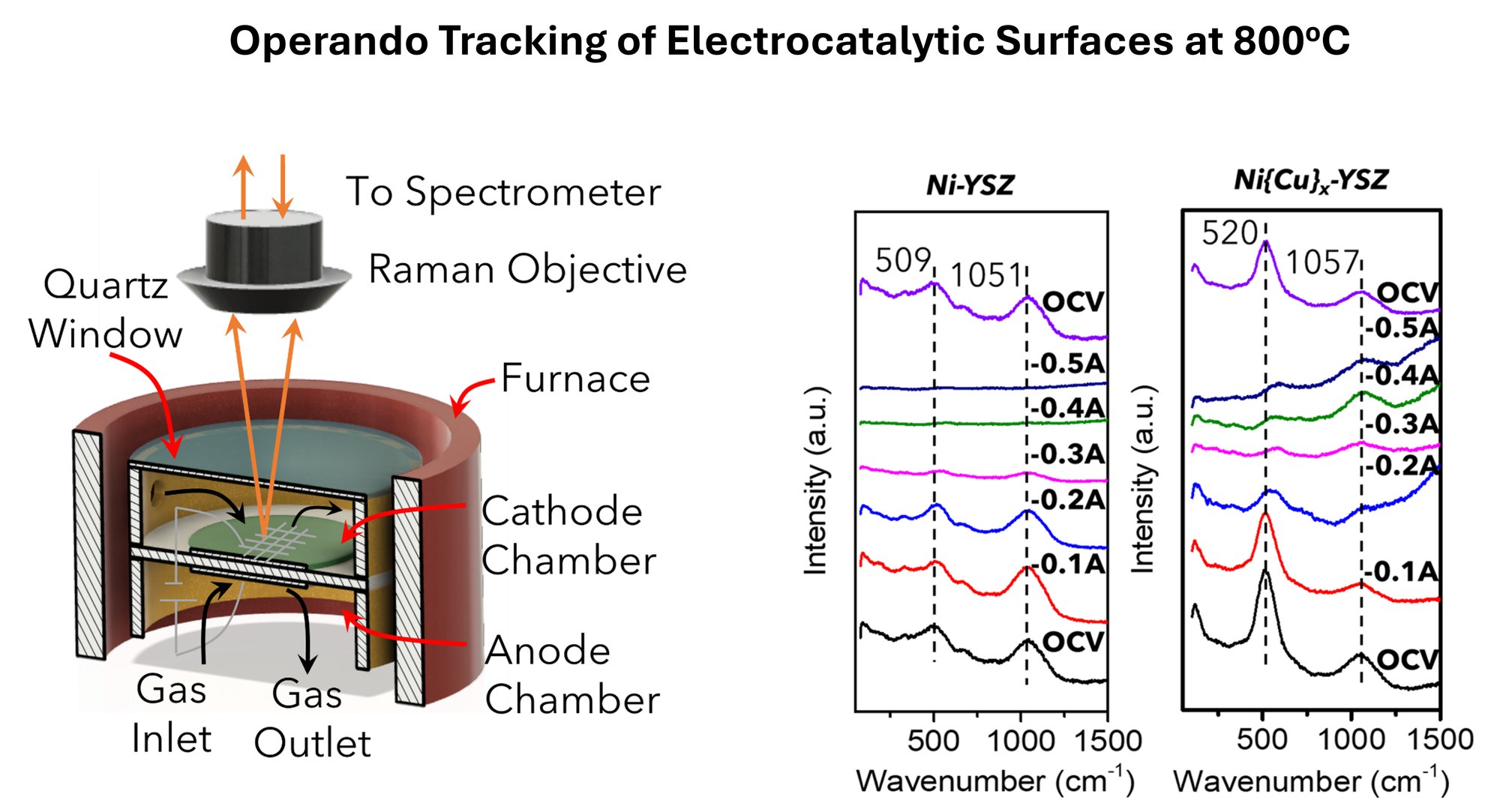
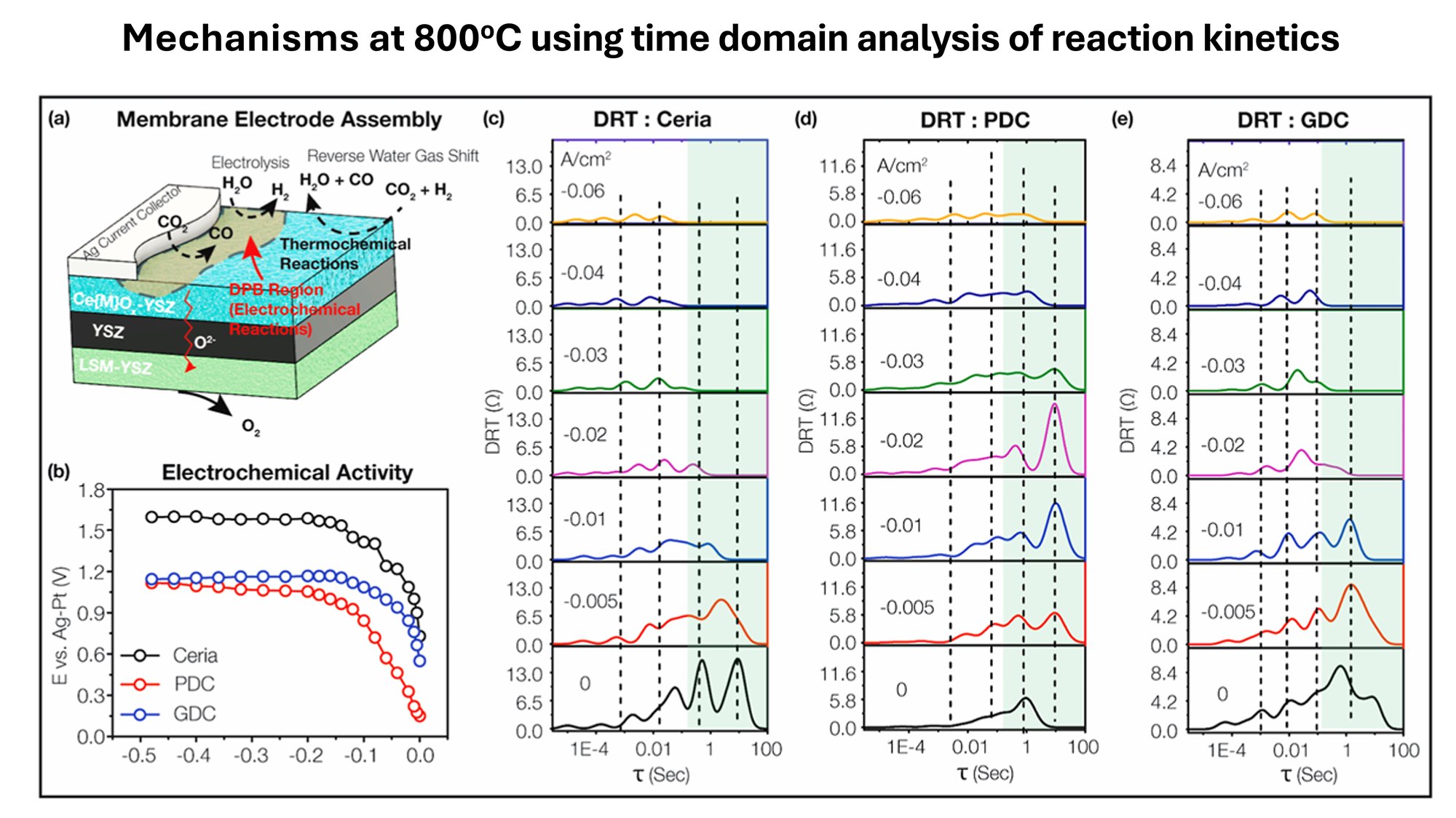
We designed and built a two-chamber operando cell that records four diagnostics at the same time at 800 °C and 1 atm, while simulating the real operating environment. Raman spectroscopy gives a molecular fingerprint of the electrode surface; optical microscopy films phase changes and heterogeneity; impedance spectroscopy, analysed by the distribution of relaxation times, separates resistances at different timescales; and online mass spectrometry tracks products and transients. Precise three-electrode geometries make electrode comparisons meaningful.
CO2 reduction on doped-ceria electrodes: controlling CO selectivity and coking with applied bias
Vipin Kamboj, Soham Raychowdhury, Shivam, Chinmoy Ranjan*
J. Mater. Chem. A, 14, 8400–8411 (2026) · doi:10.1039/D5TA09656A
Operando studies on solid oxide ceria electrodes during CO2 electroreduction
Vipin Kamboj, Soham Raychowdhury, Chinmoy Ranjan*
Appl. Catal. B Environ. Energy, 365, 124880 (2025) · doi:10.1016/j.apcatb.2024.124880
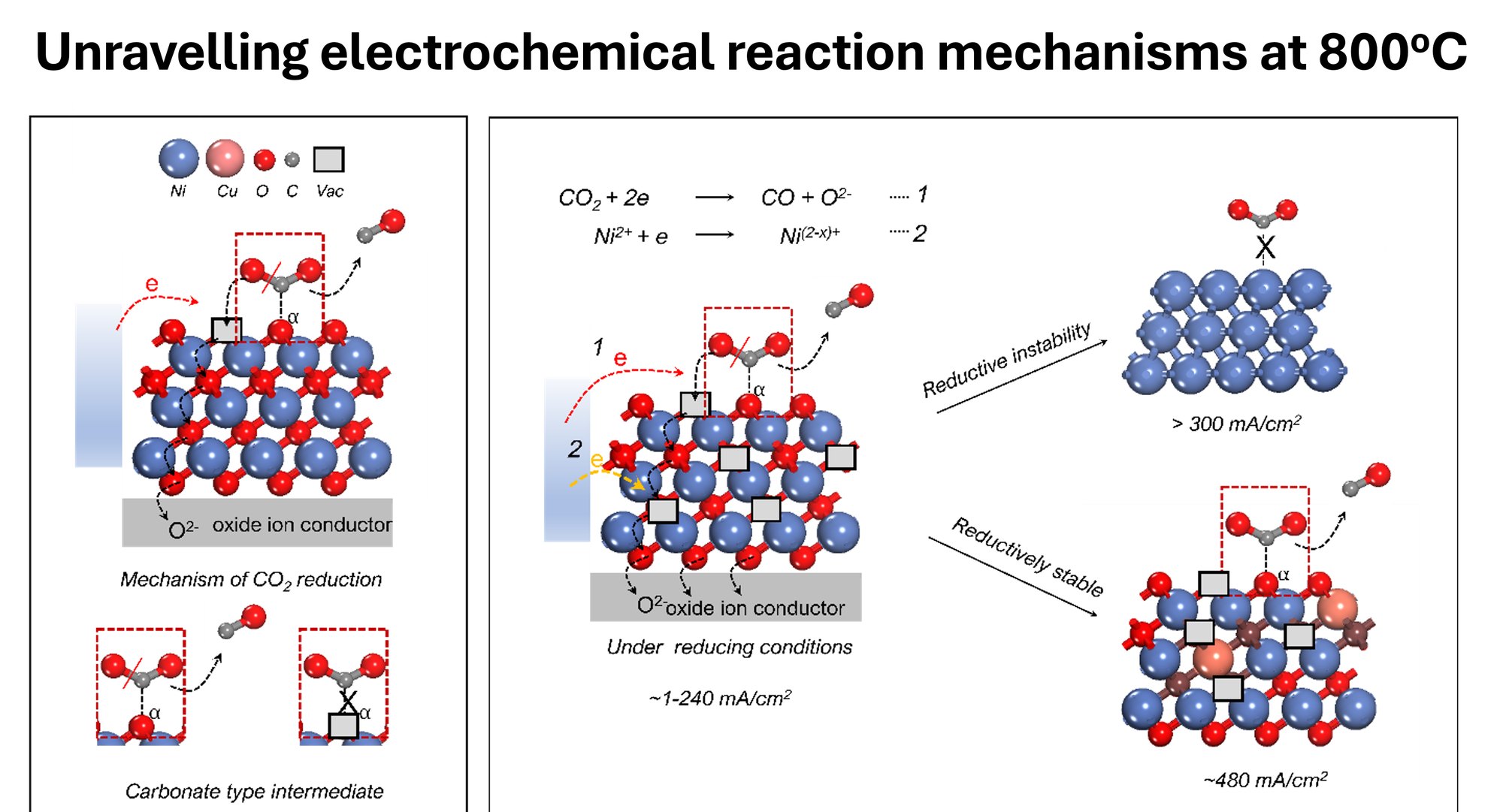
Enabling pure CO2 reduction on Ni{Cu}x-YSZ electrode via an oxide-mediated mechanism Best Paper Award, ICCCU 2024
Vipin Kamboj, Soham Raychowdhury, Chinmoy Ranjan*
Appl. Catal. B Environ. Energy, 344, 123631 (2024) · doi:10.1016/j.apcatb.2023.123631
Suppressing H2O2 formation in oxygen reduction reaction using Co-doped Cu electrodes
Sekhar Kumar Biswal, Chinmoy Ranjan*
J. Mater. Chem. A, 10, 22042–22057 (2022) · doi:10.1039/D2TA04349A